The Honest cPanel Alternative in 2026: Why Hosting Operators Are Switching to OpenPanel
If you're shopping for a cPanel alternative in 2026, you've probably already done the math. The WebPros licensing model: per-account, annually increasing, no ceiling -has pushed a lot of small-to-medium hosting operators to start looking around.
The problem is that most "cPanel alternative" roundups are thin affiliate content that lists five panels, praises all of them equally, and doesn't actually help anyone make a decision.
This post is different. It's written by the OpenPanel team, so you know where we stand, but we've tried to be direct about where cPanel still wins, where migration is genuinely painful, and who should probably stay put. If OpenPanel isn't the right fit for your operation, we'd rather you know that upfront.
First, Let's Talk About What Happened to cPanel
If you've been in hosting for more than a few years, you remember when cPanel was a flat-fee product. One price, unlimited accounts. Around $45/month and you were done.
Then Oakley Capital acquired cPanel in 2018. In 2019, they scrapped the unlimited model completely and switched to per-account pricing. Hosts with thousands of accounts saw their bills jump 500% overnight. The community was furious. Nothing changed.
Since then, the price has gone up every single year without exception:
| Year | Premier (100 accounts) |
|---|---|
| 2019 | $45/month |
| 2023 | ~$55/month |
| 2025 | $47–49/month (NOC) |
| 2026 | $69/month (retail) |
And here's the part that should concern you: in 2020, Oakley Capital also bought Plesk - cPanel's main competitor. Both are now owned by the same company, WebPros. There is no competitive pressure anymore. Prices will keep going up because there's no reason for them not to. 🤷🏻♂️
If you're a small operator running 10–50 client sites, you're paying for a product that was designed for enterprise hosting companies, built by a team that doesn't care much whether you stay or go.
What to Actually Look for in a cPanel Alternative
Most operators migrating away from cPanel have the same checklist, even if they haven't written it down:
- Multi-user support. Not just one site — multiple clients, each with their own login, file manager, and databases, with no visibility into each other's accounts.
- Real isolation. On traditional shared servers, one compromised site can pivot to the entire box. This is an area where cPanel has always relied on third-party add-ons (CloudLinux, primarily) to patch a fundamental architectural gap.
- WordPress management. The majority of hosted sites run WordPress. Auto-installs, caching integration, debugging tools, and backup management all need to work without custom scripting.
- Billing integration. Automated provisioning via WHMCS or equivalent is non-negotiable for operations running more than a handful of accounts.
- Predictable, proportional pricing. The whole point of running your own hosting is margin. A licensing model that grows with your success destroys that.
Most alternatives fail at one or two of these. Below is how OpenPanel addresses each one — and where the gaps still exist.
What OpenPanel Actually Is
OpenPanel is a hosting control panel built around Docker containers. That's the core idea that makes it different from everything else.
In a traditional setup — cPanel, Plesk, DirectAdmin — all your users share the same server environment. The same PHP installation, the same MySQL, often the same web server configuration. Isolation is bolt-on, not built-in.
OpenPanel gives each user their own Docker container. Their own MySQL instance. Their own PHP version. Their own web server — you can run Nginx for one client and Apache for another on the same machine. None of them can see each other's files or processes, because they're genuinely separated at the container level, not just at the filesystem permission level.
This matters more than most people realize. It means:
- One client can't accidentally take down another's site by hammering resources
- A compromised WordPress install on Client A's account can't pivot to Client B's files
- You can give clients actual root-level access to their container without worrying about what they'll break
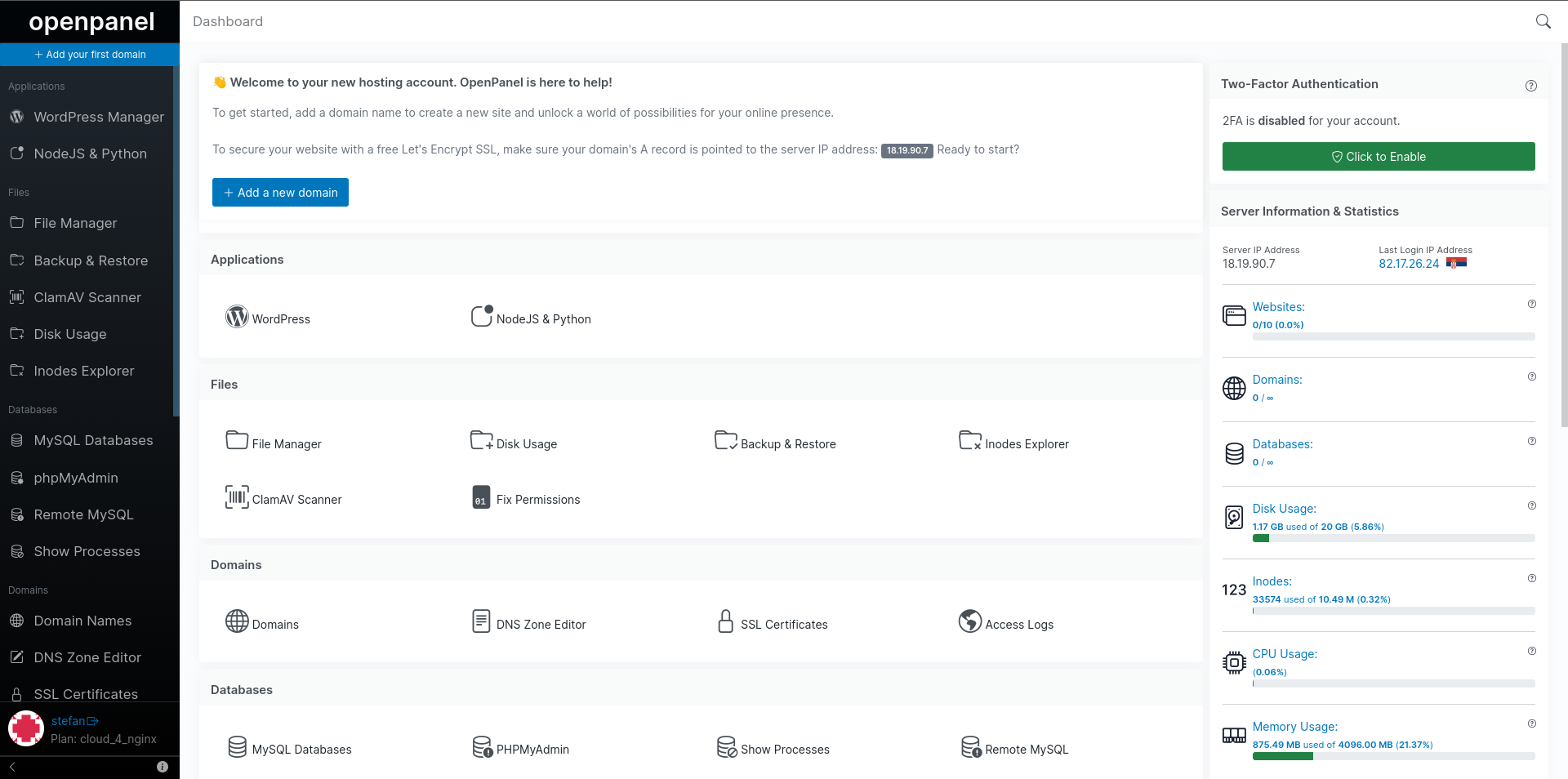
The admin interface (OpenAdmin) is where you manage everything from the server side: create users, set plan limits, monitor resource usage, manage the firewall, configure branding. The user-facing panel (OpenPanel) is what your clients log into — it's clean, modern, mobile-responsive, and has dark mode if that matters to your clients.
The Feature-by-Feature Comparison
Here's a direct look at what operators gain and what they trade when switching from cPanel to OpenPanel.
What OpenPanel does better
Security architecture. The Docker-per-user model is genuinely better than what cPanel offers. cPanel's security is largely CloudLinux-dependent — you often need to pay for CloudLinux on top of cPanel to get real isolation. OpenPanel includes this by design, for free.
Web server flexibility. With cPanel you're largely stuck with Apache (or Nginx in front of Apache via EA-Nginx). OpenPanel lets you assign Nginx, Apache, OpenResty, or OpenLiteSpeed per user. Not per server — per user. If a client needs OpenLiteSpeed for caching reasons, fine. Everyone else can stay on Nginx.
MySQL per user. Each user gets their own MySQL/MariaDB/Percona instance with configurable limits. In cPanel, all databases live in the same MySQL server, which means one runaway query can affect every other user on the box.
Resource limiting. You can set hard limits on CPU, memory, disk, port speed, and inodes — per plan, not just per user. So your "Basic" plan literally cannot exceed the resources you've allocated, regardless of what's running inside the container.
Price. OpenPanel Community Edition is free for up to 3 users and 50 websites. The Enterprise Edition — which adds email, FTP, Docker management, and removes all limits — is €14.95/month. Flat. No per-account fees. No annual hikes (so far). For a 30-account operation, you're looking at roughly $16/month vs. $53/month for a comparable cPanel license.
Where cPanel still wins
Ecosystem and familiarity. cPanel has been around since 1996. Your clients might already know it. Your junior staff might already know it. That's real. Switching panels means a learning curve for everyone involved, including you.
Third-party integrations. cPanel integrates with more billing platforms, more registrars, more DNS providers. OpenPanel has WHMCS, Blesta, FOSSBilling, and an API — which covers most cases — but if you're deeply embedded in a more obscure stack, check first.
Email hosting. This is worth flagging honestly: OpenPanel's email features are in the Enterprise Edition and are newer than the rest of the product. If email hosting is a core part of your business, test it thoroughly before committing.
Established documentation. Seven years of Stack Overflow answers, YouTube tutorials, and forum threads exist for cPanel. OpenPanel's docs are good and actively maintained, but the community knowledge base is obviously smaller.
Real Numbers: Running 10 Client Sites
Here's what a small hosting operation actually costs with each panel, using real 2026 pricing.
cPanel Pro (up to 30 accounts)
- License: $53/month
- Hetzner CX31 VPS (4 vCPU, 8GB RAM): ~$15/month
- Total: ~$68/month
OpenPanel Enterprise
- License: €14.95/month (~$16)
- Same Hetzner CX31 VPS: ~$15/month
- Total: ~$31/month
That's $37/month back in your pocket. Per year, that's $444 — nearly half a cPanel license just handed back to you. If you're charging clients $10–15/month for hosting, that difference pays for 3–4 extra client slots before you even break even on cPanel.
How Migration Actually Works
Migration from cPanel to any other panel has a reputation for being painful, and that reputation is partly earned. But OpenPanel has a meaningful advantage here that most alternatives don't: native cPanel backup import.
If you've generated a full cPanel backup (the .tar.gz files produced by cPanel's backup wizard), OpenPanel can import them directly. That means your files, databases, email accounts, and DNS records come across without manual extraction or restructuring. For most sites, this alone cuts migration time from hours to minutes per account.
The overall process looks like this:
- Install OpenPanel on a new VPS
- Generate full cPanel backups for each account you're moving (cPanel → Backup Wizard → Full Backup)
- Create matching hosting plans with equivalent resource limits
- Import the backups directly into OpenPanel via the admin interface or CLI
- Update nameservers or DNS A records once you've verified each site loads correctly
- Cancel the old server after a 24–48 hour overlap period to catch anything missed
For a 5–10 account operation, this is realistically a few hours of work, not a weekend. For larger migrations, batching by 10–20 accounts per session keeps it manageable.
A few things worth knowing before you start: DNS propagation takes time regardless of which panel you're on, so plan the cutover during low-traffic windows. And if any accounts have custom cPanel-specific configurations (EasyApache-compiled modules, custom WHM hooks), those will need manual review as the backup import handles data, not bespoke server config.
The OpenCLI can also automate plan and account creation at scale, which is useful if you're migrating dozens of accounts and want to script the provisioning step rather than clicking through the UI for each one.
Who Should Actually Switch
OpenPanel is a strong fit for:
- Freelancers and small agencies managing 5–50 client sites who want real per-user isolation without paying for CloudLinux on top of cPanel
- Operators starting a hosting reseller business who want to avoid the per-account licensing trap from day one
- Homelab and dev environments that need multi-user isolation without enterprise pricing
- Anyone already on the fence about cPanel whose 2026 renewal invoice made the decision for them
It's probably not the right move for:
- Operations where clients are contractually entitled to cPanel access specifically
- Large managed WordPress platforms that have years of tooling built against the cPanel/WHM API
- Teams where cPanel muscle memory is deeply embedded and there's no bandwidth for retraining right now
The Bottom Line
cPanel is a capable product with an increasingly difficult business model. Since the WebPros acquisition, it has been on a consistent upward pricing trajectory — and with Plesk under the same ownership, there's no competitive pressure to change that. Small operators are effectively subsidizing infrastructure and licensing costs designed for companies 100x their size.
OpenPanel was built specifically to address this gap. The Docker-per-user architecture provides genuine isolation that cPanel requires third-party add-ons to approximate. The feature set: multi-user management, web-server-per-user, MySQL-per-user, WHMCS integration, cPanel backup import.. covers everything a small-to-medium hosting operation needs. And at €14.95/month flat, the pricing doesn't punish growth.
Also, the Community Edition is free to install:
bash <(curl -sSL https://openpanel.org)
If you want to test the full feature set including: cPanel backup import and WHMCS provisioning - the Enterprise Edition is available with no per-account fees and no long-term commitment required.
Questions about migrating from cPanel? Open a thread in the OpenPanel community — the team responds there.