Edit VirtualHost Templates
Domains > VirtualHost Templates holds the configuration templates used when a domain is added:
- Apache VirtualHost: VirtualHost of domains added by users with the Apache webserver.
- Nginx VirtualHost: VirtualHost of domains added by users with the Nginx webserver.
- OpenResty VirtualHost: VirtualHost of domains added by users with the OpenResty webserver.
- Varnish Template: the
default.vclapplied to Varnish instances created for new user accounts. - Caddy VHosts: the template applied to all newly added domains for the front-facing Caddy webserver.
Changes apply only to domains added after you save, existing domains keep their configuration.
These templates have no live preview, so when any of them is changed from its default a warning is shown under the editor: editing them is recommended for advanced users only, and after changing one you should test that everything still works by adding a new user and domain.
The default page and the pages shown on suspended domains and accounts are on the Domain Templates tab.
Apache VirtualHost
This is the template used for creating VirtualHosts of domains added by users when using the Apache webserver.
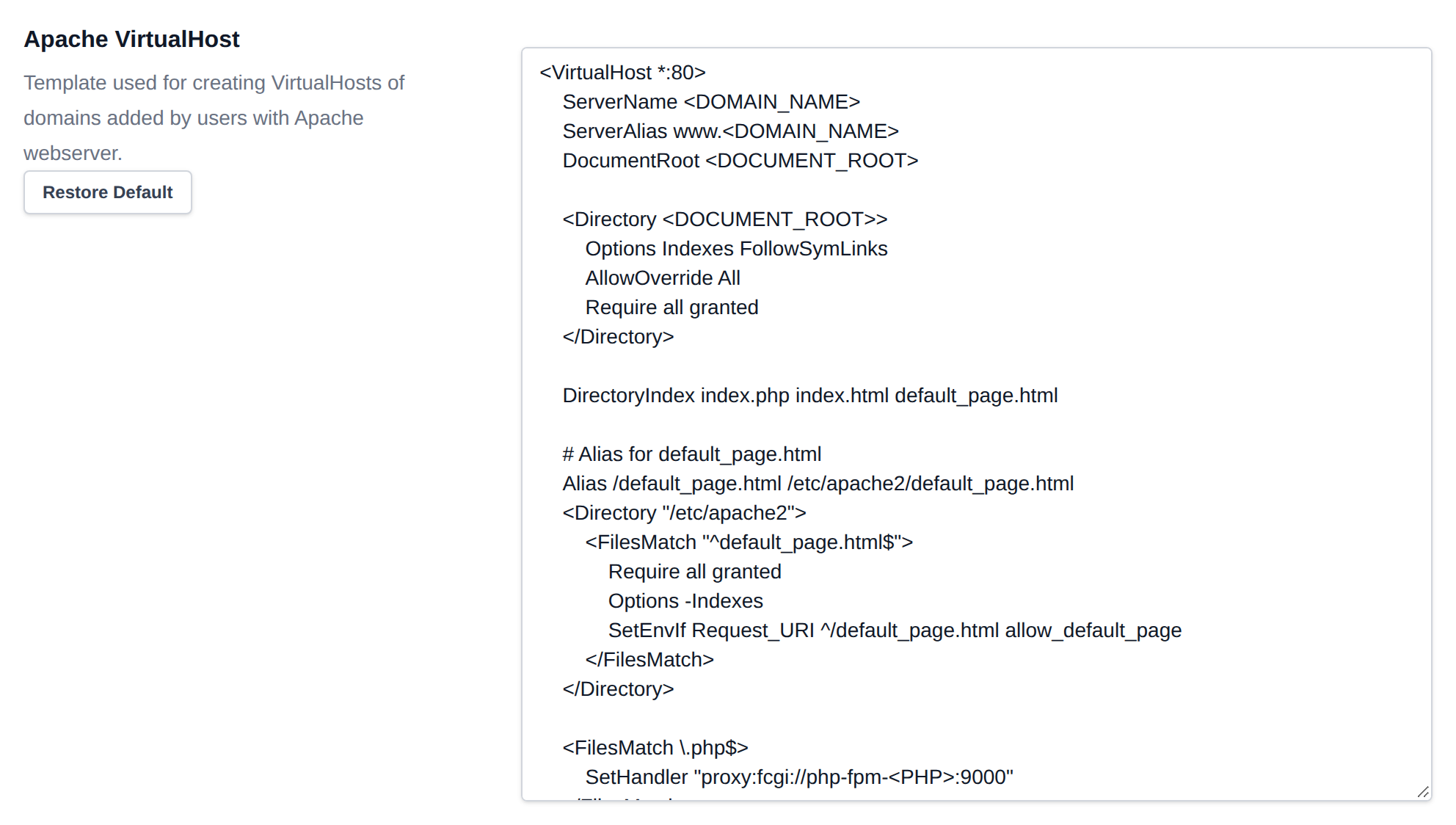
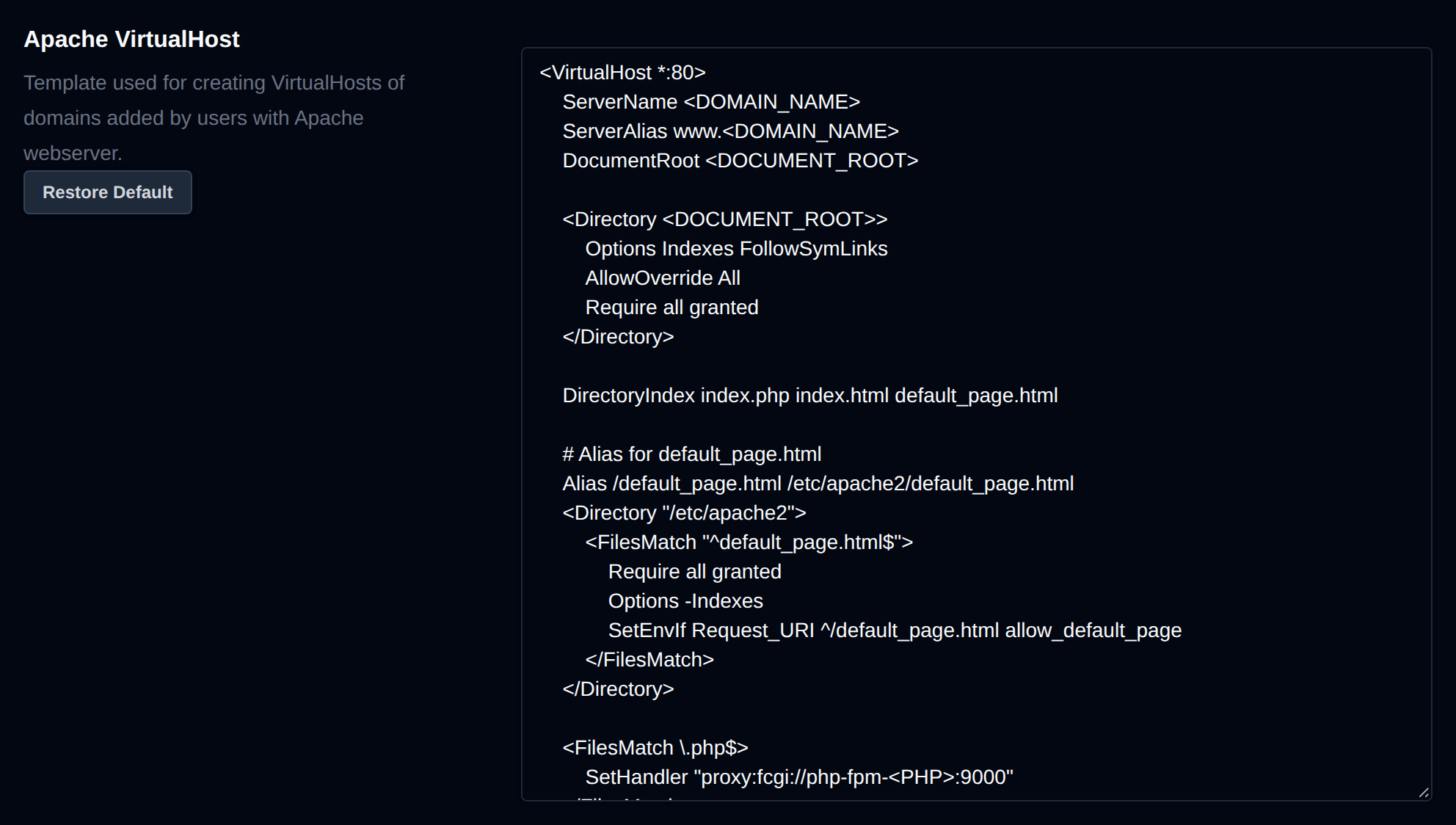
<VirtualHost *:80>
    ServerName <DOMAIN_NAME>
    ServerAlias www.<DOMAIN_NAME>
    DocumentRoot <DOCUMENT_ROOT>

    <Directory <DOCUMENT_ROOT>>
        Options Indexes FollowSymLinks
        AllowOverride All
        Require all granted
    </Directory>

    DirectoryIndex index.php index.html default_page.html

    # Alias for default_page.html
    Alias /default_page.html /etc/apache2/default_page.html
    <Directory "/etc/apache2">
        <FilesMatch "^default_page.html$">
            Require all granted
            Options -Indexes
            SetEnvIf Request_URI ^/default_page.html allow_default_page
        </FilesMatch>
    </Directory>

    <FilesMatch \.php$>
        SetHandler "proxy:fcgi://php-fpm-<PHP>:9000"
    </FilesMatch>

</VirtualHost>


<VirtualHost *:443>
    ServerName <DOMAIN_NAME>
    ServerAlias www.<DOMAIN_NAME>
    DocumentRoot <DOCUMENT_ROOT>
    SSLEngine on
    SSLCertificateFile /etc/apache2/ssl/cert.crt
    SSLCertificateKeyFile /etc/apache2/ssl/cert.key

    <Directory <DOCUMENT_ROOT>>
        Options Indexes FollowSymLinks
        AllowOverride All
        Require all granted
    </Directory>

    DirectoryIndex index.php index.html default_page.html

    # Alias for default_page.html
    Alias /default_page.html /etc/apache2/default_page.html
    <Directory "/etc/apache2">
        <FilesMatch "^default_page.html$">
            Require all granted
            Options -Indexes
            SetEnvIf Request_URI ^/default_page.html allow_default_page
        </FilesMatch>
    </Directory>

    <FilesMatch \.php$>
        SetHandler "proxy:fcgi://php-fpm-<PHP>:9000"
    </FilesMatch>

</VirtualHost>
- Edit the code in the editor.
- When finished, click Save Files to apply your changes.
To revert to the original Apache template:
- Click Restore Default to reload the version from GitHub.
- Don’t forget to click Save Files afterward to confirm the reset.
Nginx VirtualHost
This is the template used for creating VirtualHosts of domains added by users when using the Nginx webserver.
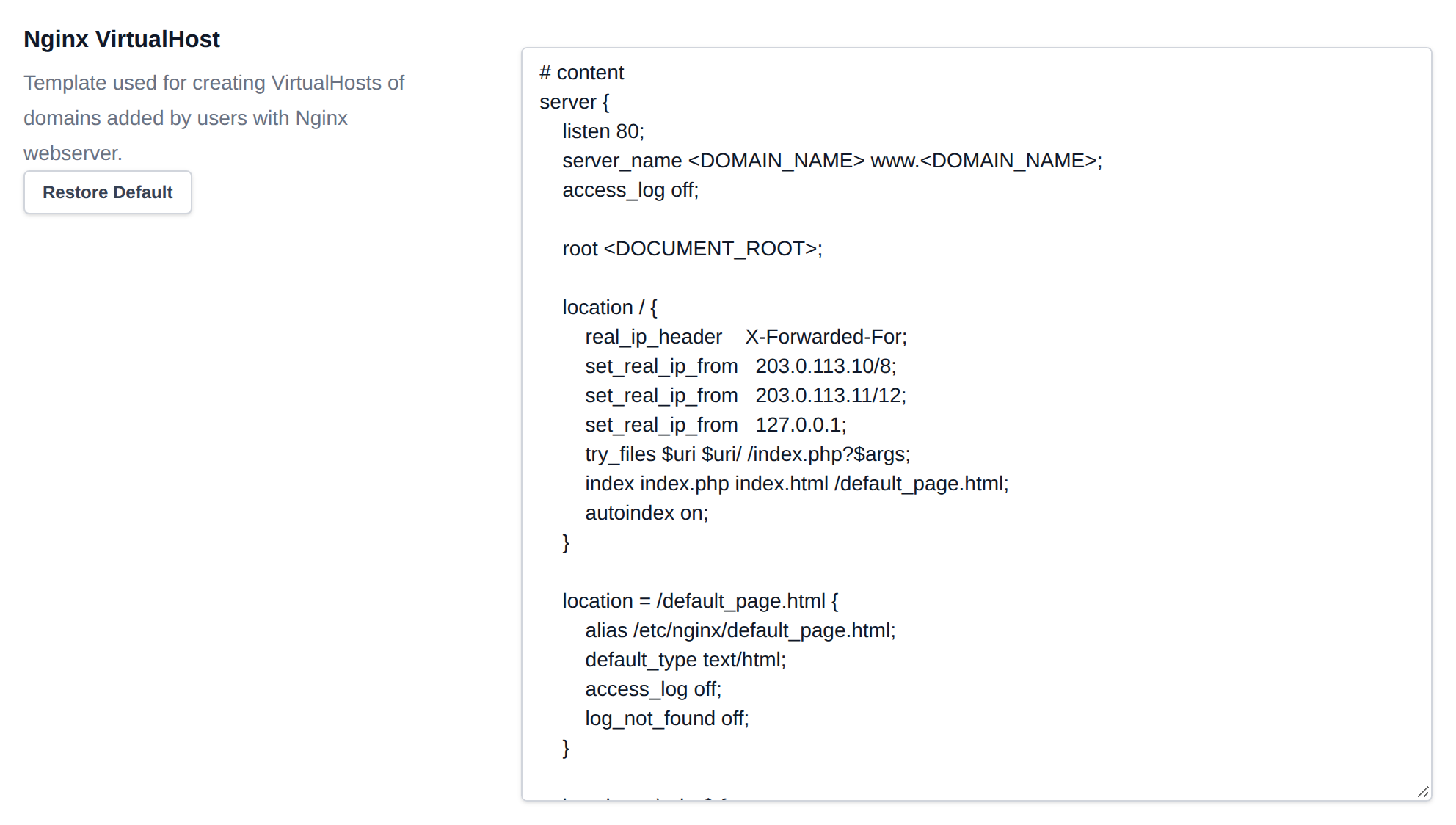
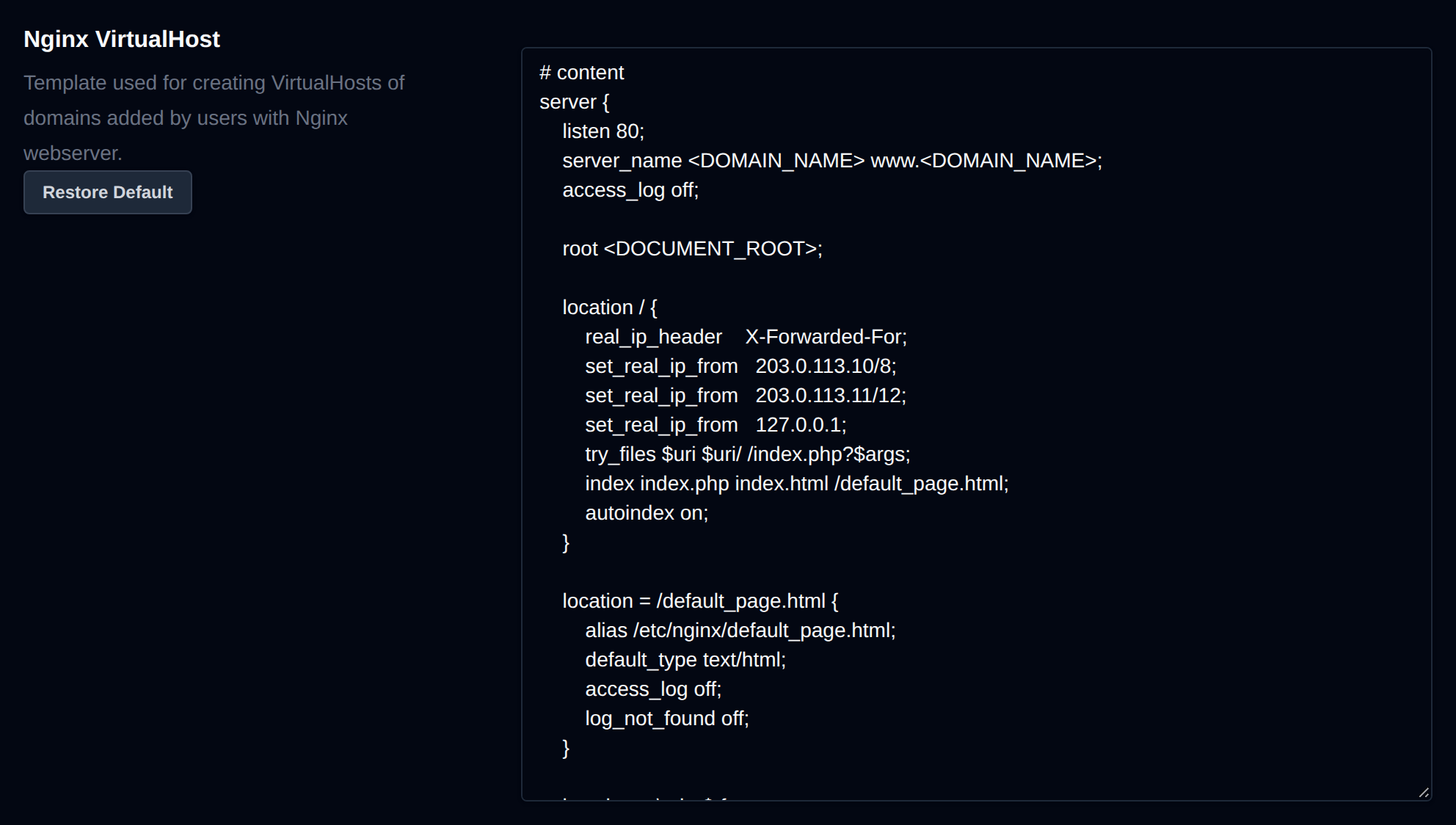
# content
server {
    listen 80;
    server_name <DOMAIN_NAME> www.<DOMAIN_NAME>;
    access_log off;

    root <DOCUMENT_ROOT>;

    location / {
        real_ip_header    X-Forwarded-For;
        set_real_ip_from   172.17.0.0/16;
        try_files $uri $uri/ /index.php?$args;
        index index.php index.html /default_page.html;
        autoindex on;
    }

    location = /default_page.html {
        alias /etc/nginx/default_page.html;
        default_type text/html;
        access_log off;
        log_not_found off;
    }

    location ~ \.php$ {
        include fastcgi_params;
        fastcgi_pass php-fpm-<PHP>:9000;
        fastcgi_param SCRIPT_FILENAME $document_root$fastcgi_script_name;
        include fastcgi_params;
    }

    location ~* \.(js|css|png|jpg|jpeg|gif|ico)$ {
        expires max;
        log_not_found off;
    }

    location = /favicon.ico {
        log_not_found off;
        access_log off;
    }

    location = /robots.txt {
        allow all;
        log_not_found off;
        access_log off;
    }

}


server {
    listen 443 ssl;
    http2 on; #nginx >= 1.25.1
    server_name <DOMAIN_NAME> www.<DOMAIN_NAME>;
    access_log off;

    root <DOCUMENT_ROOT>;

    # SSL Configuration
    ssl_certificate /etc/nginx/ssl/cert.crt;
    ssl_certificate_key /etc/nginx/ssl/cert.key;
    ssl_protocols TLSv1.2 TLSv1.3;
    ssl_prefer_server_ciphers on;
    ssl_ciphers "EECDH+AESGCM:EDH+AESGCM:AES256+EECDH:AES256+EDH";

    location / {
        real_ip_header    X-Forwarded-For;
        set_real_ip_from   172.17.0.0/16;
        try_files $uri $uri/ /index.php?$args;
        index index.php index.html /default_page.html;
        autoindex on;
    }


    location = /default_page.html {
        alias /etc/nginx/default_page.html;
        default_type text/html;
        access_log off;
        log_not_found off;
    }


    location ~ \.php$ {
        include fastcgi_params;
        fastcgi_pass php-fpm-<PHP>:9000;
        fastcgi_param SCRIPT_FILENAME $document_root$fastcgi_script_name;
        include fastcgi_params;
    }

    location ~* \.(js|css|png|jpg|jpeg|gif|ico)$ {
        expires max;
        log_not_found off;
    }

    location = /favicon.ico {
        log_not_found off;
        access_log off;
    }

    location = /robots.txt {
        allow all;
        log_not_found off;
        access_log off;
    }

}
- Edit the code in the editor.
- When finished, click Save Files to apply your changes.
To revert to the original Nginx template:
- Click Restore Default to reload the version from GitHub.
- Don’t forget to click Save Files afterward to confirm the reset.
OpenResty VirtualHost
This is the template used for creating VirtualHosts of domains added by users when using the OpenResty webserver.
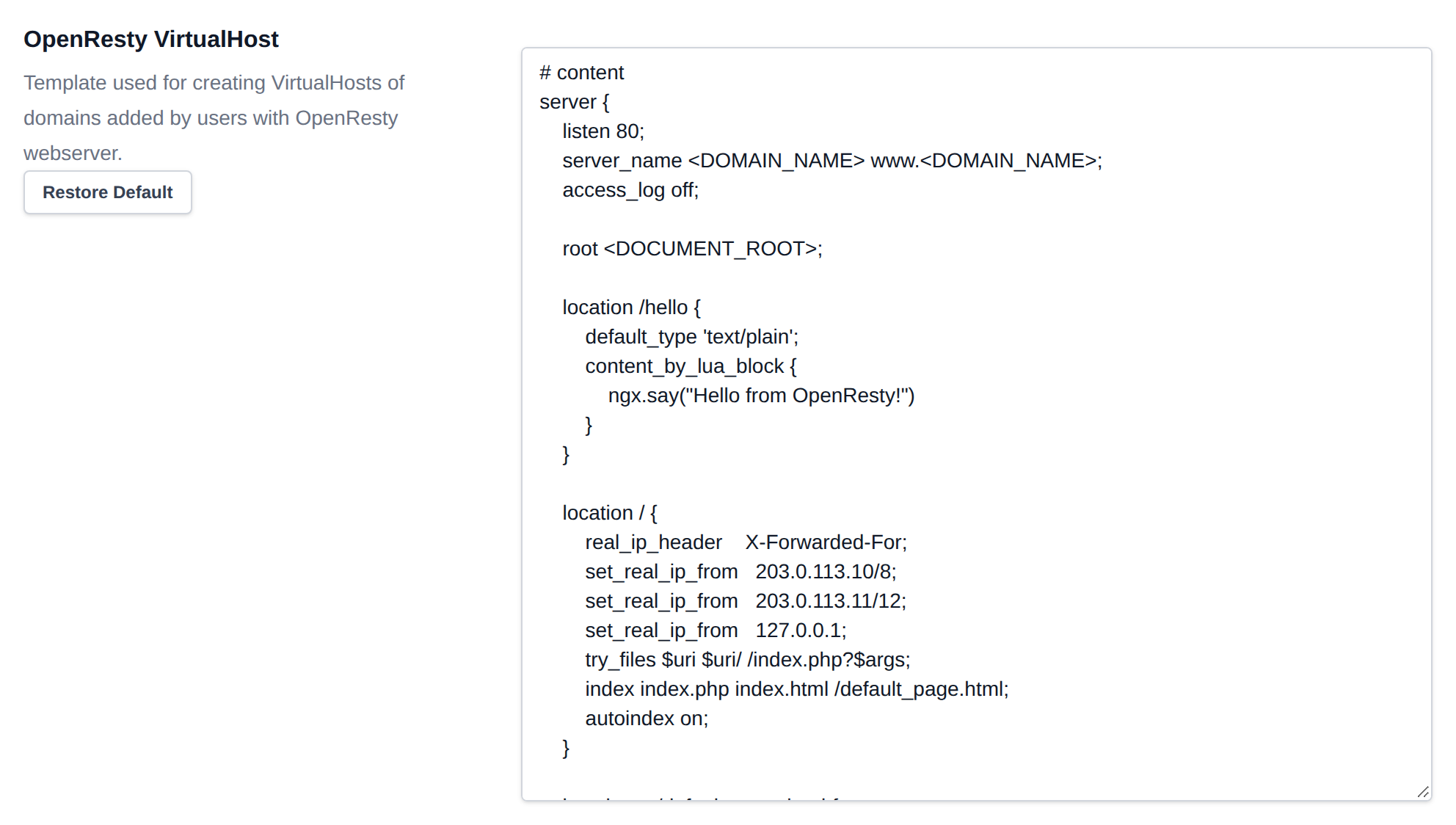
# content
server {
    listen 80;
    server_name <DOMAIN_NAME> www.<DOMAIN_NAME>;
    access_log off;

    root <DOCUMENT_ROOT>;

    location /hello {
        default_type 'text/plain';
        content_by_lua_block {
            ngx.say("Hello from OpenResty!")
        }
    }

    location / {
        real_ip_header    X-Forwarded-For;
        set_real_ip_from   172.17.0.0/16;
        try_files $uri $uri/ /index.php?$args;
        index index.php index.html /default_page.html;
        autoindex on;
    }

    location = /default_page.html {
        alias /etc/nginx/default_page.html;
        default_type text/html;
        access_log off;
        log_not_found off;
    }

    location ~ \.php$ {
        include fastcgi_params;
        fastcgi_pass php-fpm-<PHP>:9000;
        fastcgi_param SCRIPT_FILENAME $document_root$fastcgi_script_name;
        include fastcgi_params;
    }

    location ~* \.(js|css|png|jpg|jpeg|gif|ico)$ {
        expires max;
        log_not_found off;
    }

    location = /favicon.ico {
        log_not_found off;
        access_log off;
    }

    location = /robots.txt {
        allow all;
        log_not_found off;
        access_log off;
    }

}


server {
    listen 443 ssl;
    http2 on; #nginx >= 1.25.1
    server_name <DOMAIN_NAME> www.<DOMAIN_NAME>;
    access_log off;

    root <DOCUMENT_ROOT>;

    # SSL Configuration
    ssl_certificate /etc/nginx/ssl/cert.crt;
    ssl_certificate_key /etc/nginx/ssl/cert.key;
    ssl_protocols TLSv1.2 TLSv1.3;
    ssl_prefer_server_ciphers on;
    ssl_ciphers "EECDH+AESGCM:EDH+AESGCM:AES256+EECDH:AES256+EDH";

    location /hello {
        default_type 'text/plain';
        content_by_lua_block {
            ngx.say("Hello from OpenResty!")
        }
    }

    location / {
        real_ip_header    X-Forwarded-For;
        set_real_ip_from   172.17.0.0/16;
        try_files $uri $uri/ /index.php?$args;
        index index.php index.html /default_page.html;
        autoindex on;
    }

    location = /default_page.html {
        alias /etc/nginx/default_page.html;
        default_type text/html;
        access_log off;
        log_not_found off;
    }

    location ~ \.php$ {
        include fastcgi_params;
        fastcgi_pass php-fpm-<PHP>:9000;
        fastcgi_param SCRIPT_FILENAME $document_root$fastcgi_script_name;
        include fastcgi_params;
    }

    location ~* \.(js|css|png|jpg|jpeg|gif|ico)$ {
        expires max;
        log_not_found off;
    }

    location = /favicon.ico {
        log_not_found off;
        access_log off;
    }

    location = /robots.txt {
        allow all;
        log_not_found off;
        access_log off;
    }

}
- Edit the code in the editor.
- When finished, click Save Files to apply your changes.
To revert to the original OpenResty template:
- Click Restore Default to reload the version from GitHub.
- Don’t forget to click Save Files afterward to confirm the reset.
Varnish Template
This is the template used for creating default.vcl file for users when using the Varnish Caching.
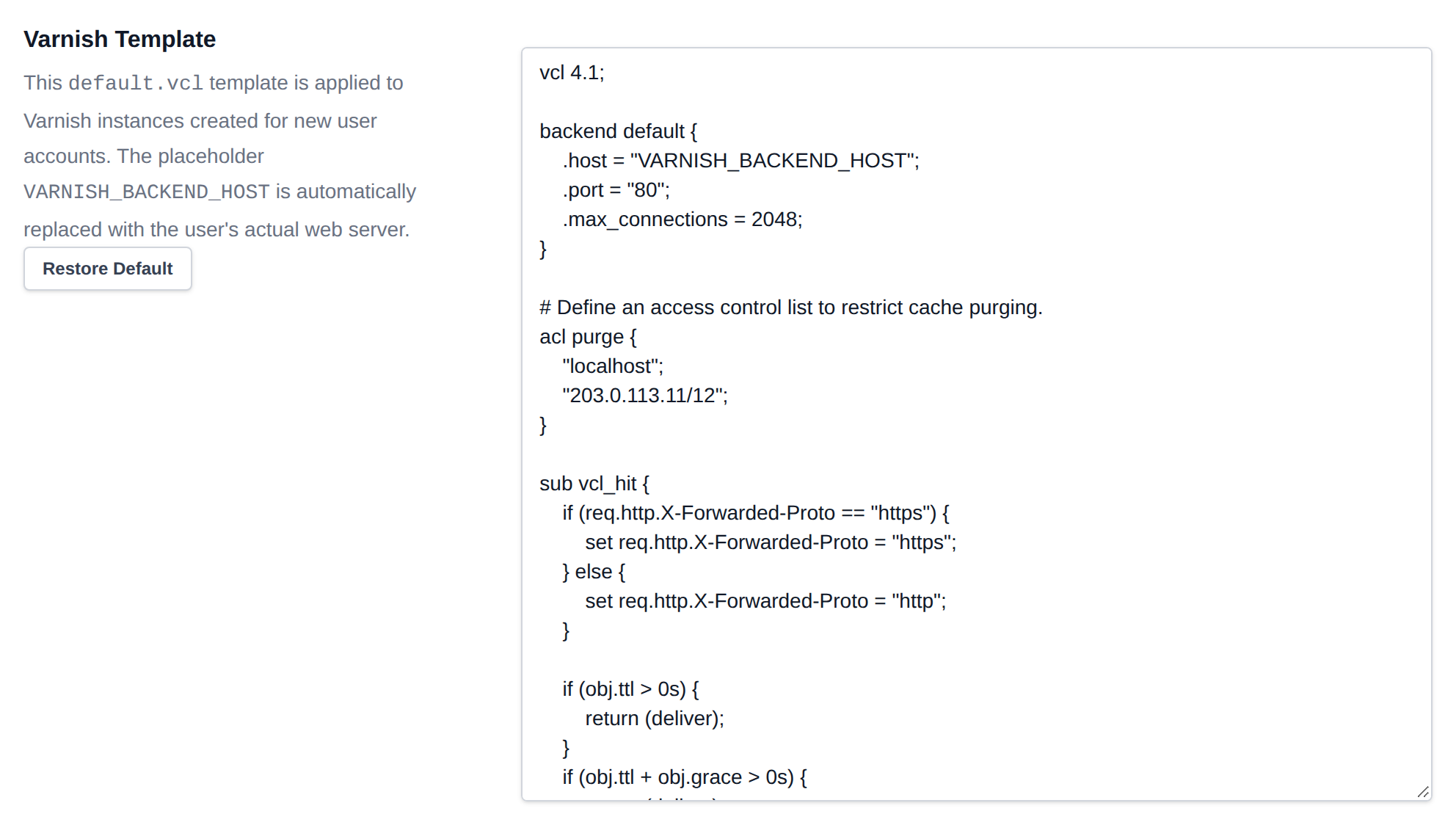
The placeholder VARNISH_BACKEND_HOST is automatically replaced with the user's actual web server - Nginx, Apache, or OpenResty.
vcl 4.1;

backend default {
    .host = "VARNISH_BACKEND_HOST";
    .port = "80";
    .max_connections = 2048;
}

# Define an access control list to restrict cache purging.
acl purge {
    "localhost";
    "172.16.0.0/12";
}

sub vcl_hit {
    if (req.http.X-Forwarded-Proto == "https") {
        set req.http.X-Forwarded-Proto = "https";
    } else {
        set req.http.X-Forwarded-Proto = "http";
    }

    if (obj.ttl > 0s) {
        return (deliver);
    }
    if (obj.ttl + obj.grace > 0s) {
        return (deliver);
    }

    return (miss);  # Use "miss" instead of "fetch"
}

sub vcl_recv {

    # Remove empty query string parameters
    # e.g.: www.example.com/index.html?
    if (req.url ~ "\?$") {
        set req.url = regsub(req.url, "\?$", "");
    }

    # Remove port number from host header
    set req.http.Host = regsub(req.http.Host, ":[0-9]+", "");

    # Remove the proxy header to mitigate the httpoxy vulnerability
    # See https://httpoxy.org/
    unset req.http.proxy;

    # Purge logic to remove objects from the cache.
    # Tailored to the Proxy Cache Purge WordPress plugin
    # See https://wordpress.org/plugins/varnish-http-purge/
    if(req.method == "PURGE") {
        if(!client.ip ~ purge) {
            return(synth(405,"PURGE not allowed for this IP address"));
        }
        if (req.http.X-Purge-Method == "regex") {
            ban("obj.http.x-url ~ " + req.url + " && obj.http.x-host == " + req.http.host);
            return(synth(200, "Purged"));
        }
        ban("obj.http.x-url == " + req.url + " && obj.http.x-host == " + req.http.host);
        return(synth(200, "Purged"));
    }

   # Only handle relevant HTTP request methods
    if (
        req.method != "GET" &&
        req.method != "HEAD" &&
        req.method != "PUT" &&
        req.method != "POST" &&
        req.method != "PATCH" &&
        req.method != "TRACE" &&
        req.method != "OPTIONS" &&
        req.method != "DELETE"
    ) {
        return (pipe);
    }

    # Remove tracking query string parameters used by analytics tools
    if (req.url ~ "(\?|&)(_branch_match_id|_bta_[a-z]+|_bta_c|_bta_tid|_ga|_gl|_ke|_kx|campid|cof|customid|cx|dclid|dm_i|ef_id|epik|fbclid|gad_source|gbraid|gclid|gclsrc|gdffi|gdfms|gdftrk|hsa_acc|hsa_ad|hsa_cam|hsa_grp|hsa_kw|hsa_mt|hsa_net|hsa_src|hsa_tgt|hsa_ver|ie|igshid|irclickid|matomo_campaign|matomo_cid|matomo_content|matomo_group|matomo_keyword|matomo_medium|matomo_placement|matomo_source|mc_[a-z]+|mc_cid|mc_eid|mkcid|mkevt|mkrid|mkwid|msclkid|mtm_campaign|mtm_cid|mtm_content|mtm_group|mtm_keyword|mtm_medium|mtm_placement|mtm_source|nb_klid|ndclid|origin|pcrid|piwik_campaign|piwik_keyword|piwik_kwd|pk_campaign|pk_keyword|pk_kwd|redirect_log_mongo_id|redirect_mongo_id|rtid|s_kwcid|sb_referer_host|sccid|si|siteurl|sms_click|sms_source|sms_uph|srsltid|toolid|trk_contact|trk_module|trk_msg|trk_sid|ttclid|twclid|utm_[a-z]+|utm_campaign|utm_content|utm_creative_format|utm_id|utm_marketing_tactic|utm_medium|utm_source|utm_source_platform|utm_term|vmcid|wbraid|yclid|zanpid)=") {
        set req.url = regsuball(req.url, "(_branch_match_id|_bta_[a-z]+|_bta_c|_bta_tid|_ga|_gl|_ke|_kx|campid|cof|customid|cx|dclid|dm_i|ef_id|epik|fbclid|gad_source|gbraid|gclid|gclsrc|gdffi|gdfms|gdftrk|hsa_acc|hsa_ad|hsa_cam|hsa_grp|hsa_kw|hsa_mt|hsa_net|hsa_src|hsa_tgt|hsa_ver|ie|igshid|irclickid|matomo_campaign|matomo_cid|matomo_content|matomo_group|matomo_keyword|matomo_medium|matomo_placement|matomo_source|mc_[a-z]+|mc_cid|mc_eid|mkcid|mkevt|mkrid|mkwid|msclkid|mtm_campaign|mtm_cid|mtm_content|mtm_group|mtm_keyword|mtm_medium|mtm_placement|mtm_source|nb_klid|ndclid|origin|pcrid|piwik_campaign|piwik_keyword|piwik_kwd|pk_campaign|pk_keyword|pk_kwd|redirect_log_mongo_id|redirect_mongo_id|rtid|s_kwcid|sb_referer_host|sccid|si|siteurl|sms_click|sms_source|sms_uph|srsltid|toolid|trk_contact|trk_module|trk_msg|trk_sid|ttclid|twclid|utm_[a-z]+|utm_campaign|utm_content|utm_creative_format|utm_id|utm_marketing_tactic|utm_medium|utm_source|utm_source_platform|utm_term|vmcid|wbraid|yclid|zanpid)=[-_A-z0-9+(){}%.*]+&?", "");
        set req.url = regsub(req.url, "[?|&]+$", "");
    }

    # Only cache GET and HEAD requests
    if (req.method != "GET" && req.method != "HEAD") {
        set req.http.X-Cacheable = "NO:REQUEST-METHOD";
        return(pass);
    }

    # Mark static files with the X-Static-File header, and remove any cookies
    # X-Static-File is also used in vcl_backend_response to identify static files
    if (req.url ~ "^[^?]*\.(7z|avi|bmp|bz2|css|csv|doc|docx|eot|flac|flv|gif|gz|ico|jpeg|jpg|js|less|mka|mkv|mov|mp3|mp4|mpeg|mpg|odt|ogg|ogm|opus|otf|pdf|png|ppt|pptx|rar|rtf|svg|svgz|swf|tar|tbz|tgz|ttf|txt|txz|wav|webm|webp|woff|woff2|xls|xlsx|xml|xz|zip)(\?.*)?$") {
        set req.http.X-Static-File = "true";
        unset req.http.Cookie;
        return(hash);
    }

    # No caching of special URLs, logged in users and some plugins
    if (
        req.http.Cookie ~ "wordpress_(?!test_)[a-zA-Z0-9_]+|wp-postpass|comment_author_[a-zA-Z0-9_]+|woocommerce_cart_hash|woocommerce_items_in_cart|wp_woocommerce_session_[a-zA-Z0-9]+|wordpress_logged_in_|comment_author|PHPSESSID" ||
        req.http.Authorization ||
        req.url ~ "add_to_cart" ||
        req.url ~ "edd_action" ||
        req.url ~ "nocache" ||
        req.url ~ "^/addons" ||
        req.url ~ "^/bb-admin" ||
        req.url ~ "^/bb-login.php" ||
        req.url ~ "^/bb-reset-password.php" ||
        req.url ~ "^/cart" ||
        req.url ~ "^/checkout" ||
        req.url ~ "^/control.php" ||
        req.url ~ "^/login" ||
        req.url ~ "^/logout" ||
        req.url ~ "^/lost-password" ||
        req.url ~ "^/my-account" ||
        req.url ~ "^/product" ||
        req.url ~ "^/register" ||
        req.url ~ "^/register.php" ||
        req.url ~ "^/server-status" ||
        req.url ~ "^/signin" ||
        req.url ~ "^/signup" ||
        req.url ~ "^/stats" ||
        req.url ~ "^/wc-api" ||
        req.url ~ "^/wp-admin" ||
        req.url ~ "^/wp-comments-post.php" ||
        req.url ~ "^/wp-cron.php" ||
        req.url ~ "^/wp-login.php" ||
        req.url ~ "^/wp-activate.php" ||
        req.url ~ "^/wp-mail.php" ||
        req.url ~ "^/wp-login.php" ||
        req.url ~ "^\?add-to-cart=" ||
        req.url ~ "^\?wc-api=" ||
        req.url ~ "^/preview=" ||
        req.url ~ "^/\.well-known/acme-challenge/"
    ) {
	     set req.http.X-Cacheable = "NO:Logged in/Got Sessions";
	     if(req.http.X-Requested-With == "XMLHttpRequest") {
		     set req.http.X-Cacheable = "NO:Ajax";
	     }
        return(pass);
    }

    # Remove any cookies left
    unset req.http.Cookie;
    return(hash);
}


sub vcl_hash {
    if(req.http.X-Forwarded-Proto) {
        # Create cache variations depending on the request protocol
        hash_data(req.http.X-Forwarded-Proto);
    }
}

sub vcl_pipe {
  if (req.http.upgrade) {
    set bereq.http.upgrade = req.http.upgrade;
  }
  return (pipe);
}

sub vcl_backend_response {
    # Inject URL & Host header into the object for asynchronous banning purposes
    set beresp.http.x-url = bereq.url;
    set beresp.http.x-host = bereq.http.host;

    # https://support.torproject.org/onionservices/onion-location/
    set beresp.http.Onion-Location = beresp.http.Onion-Location;

    # If we dont get a Cache-Control header from the backend
    # we default to 1h cache for all objects
    if (!beresp.http.Cache-Control) {
        set beresp.ttl = 1h;
        set beresp.http.X-Cacheable = "YES:Forced";
    }

    # If the file is marked as static we cache it for 1 day
    if (bereq.http.X-Static-File == "true") {
        unset beresp.http.Set-Cookie;
        set beresp.http.X-Cacheable = "YES:Forced";
        set beresp.ttl = 1d;
    }

    set beresp.grace = 6h;
    set beresp.keep = 24h;

    # Compress cacheable dynamic responses the backend didn't already gzip
    if (beresp.http.content-type ~ "text|application/javascript|application/json|application/xml|image/svg") {
        set beresp.do_gzip = true;
    }

    # Remove the Set-Cookie header when a specific Wordfence cookie is set
    if (beresp.http.Set-Cookie ~ "wfvt_|wordfence_verifiedHuman") {
        unset beresp.http.Set-Cookie;
    }

    if (beresp.http.Set-Cookie) {
        set beresp.http.X-Cacheable = "NO:Got Cookies";
    } elseif(beresp.http.Cache-Control ~ "private") {
        set beresp.http.X-Cacheable = "NO:Cache-Control=private";
    }
}


sub vcl_deliver {
    # Debug header
    if(req.http.X-Cacheable) {
        set resp.http.X-Cacheable = req.http.X-Cacheable;
    } elseif(obj.uncacheable) {
        if(!resp.http.X-Cacheable) {
            set resp.http.X-Cacheable = "NO:UNCACHEABLE";
        }
    } elseif(!resp.http.X-Cacheable) {
        set resp.http.X-Cacheable = "YES";
    }

### uncomment to remove from responses ###
#  unset resp.http.X-Powered-By;
#  unset resp.http.Server;
#  unset resp.http.server;
#  unset resp.http.via;
#  unset resp.http.x-powered-by;
#  unset resp.http.x-runtime;
#  unset resp.http.x-varnish;
    unset resp.http.x-url;
    unset resp.http.x-host;

  return (deliver);
}
- Edit the code in the editor.
- When finished, click Save Files to apply your changes.
To revert to the original Varnish template:
- Click Restore Default to reload the version from GitHub.
- Don’t forget to click Save Files afterward to confirm the reset.
Caddy VHosts
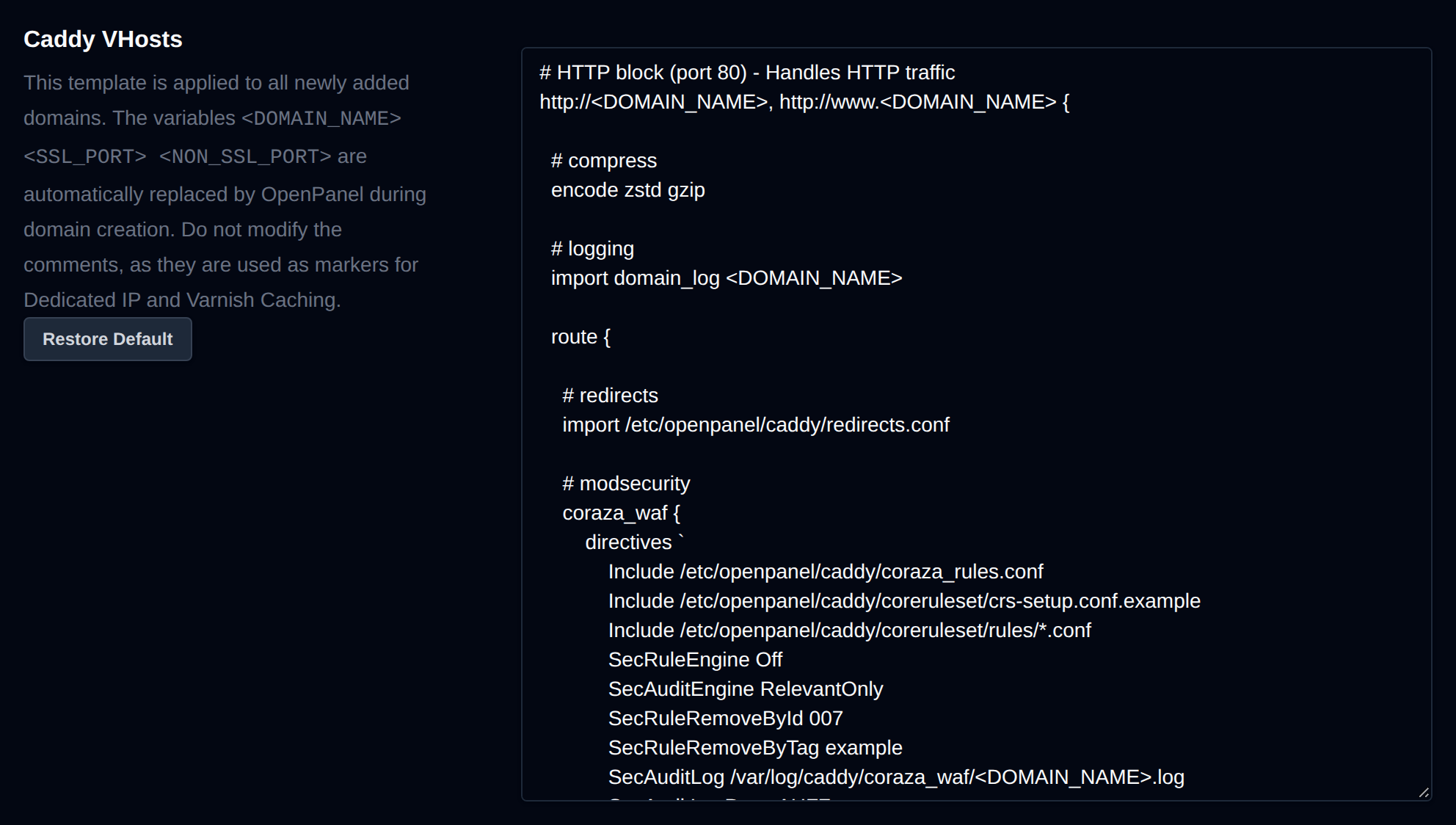
This is the template applied to all newly added domains for the front-facing Caddy webserver (Caddy handles TLS termination and reverse-proxies traffic to the domain's Apache/Nginx/OpenResty container, and enforces Coraza WAF when enabled).
The variables <DOMAIN_NAME>, <SSL_PORT>, and <NON_SSL_PORT> are automatically replaced by OpenPanel during domain creation. Do not modify the comments in the file, as they are used as markers for Dedicated IP and Varnish Caching.
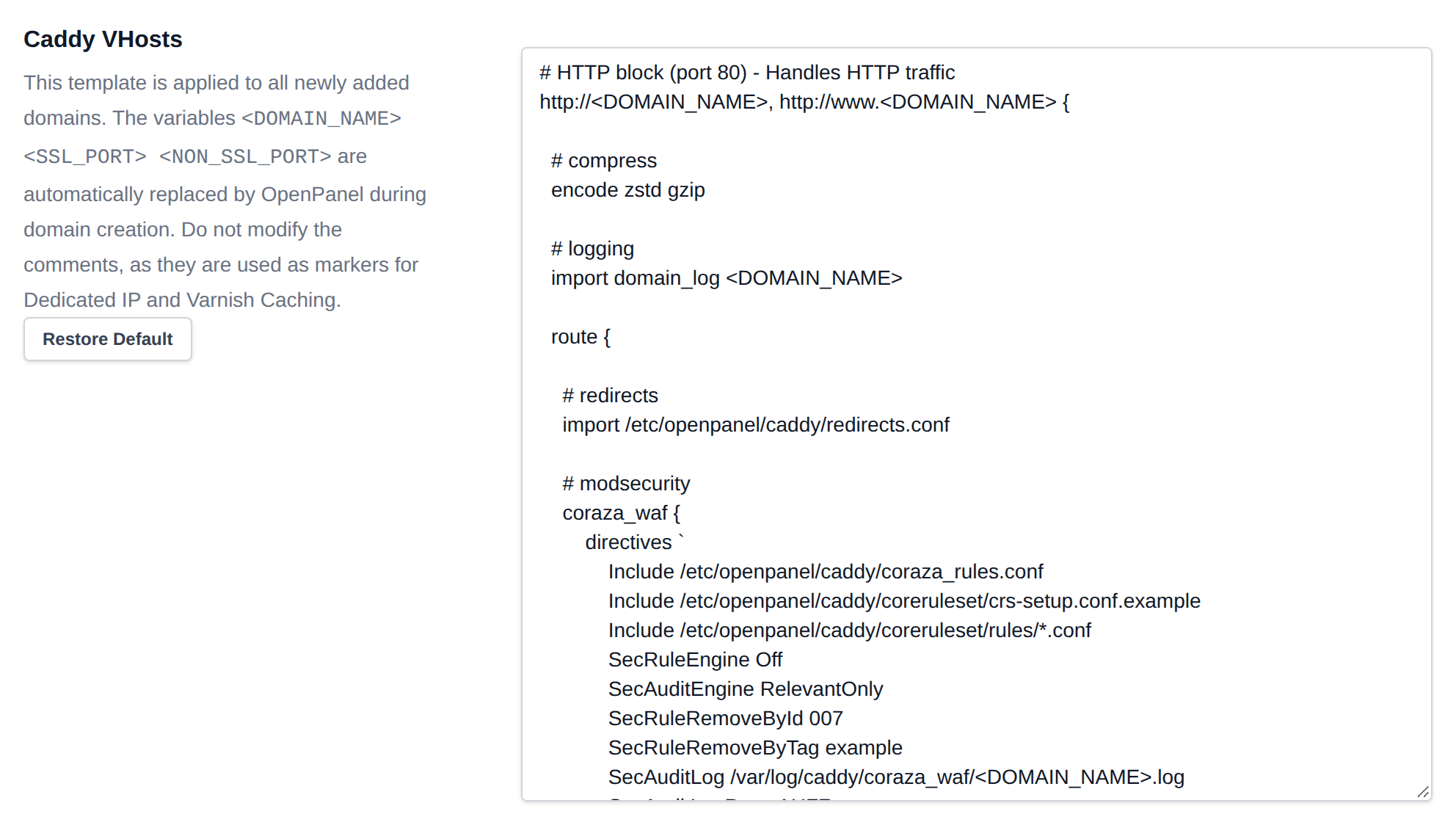
# HTTP block (port 80) - Handles HTTP traffic
http://<DOMAIN_NAME>, http://www.<DOMAIN_NAME> {

  # compress
  encode zstd gzip

  # logging
  import domain_log <DOMAIN_NAME>

  route {

    # redirects
    import /etc/openpanel/caddy/redirects.conf

    # modsecurity
    coraza_waf {
        load_owasp_crs
        directives `
            Include /etc/openpanel/caddy/coraza_rules.conf
            Include /etc/openpanel/caddy/coreruleset/crs-setup.conf.example
            Include /etc/openpanel/caddy/coreruleset/rules/*.conf
            SecRuleEngine Off
            SecAuditEngine RelevantOnly
            SecRuleRemoveById 007
            SecRuleRemoveByTag example
            SecAuditLog /var/log/caddy/coraza_waf/<DOMAIN_NAME>.log
            SecAuditLogParts AHFZ
            SecAuditLogFormat json
        `
    }

    # Handle HTTP traffic (port 80)
    reverse_proxy http://127.0.0.1:<NON_SSL_PORT> {
      header_up Host {host}
    }
  }
}


# HTTPS block (port 443) - Handles HTTPS traffic
https://<DOMAIN_NAME>, https://www.<DOMAIN_NAME> {

  # compress
  encode zstd gzip

  # logging
  import domain_log <DOMAIN_NAME>

  route {

    # redirects
    import /etc/openpanel/caddy/redirects.conf

    # modsecurity
    coraza_waf {
        load_owasp_crs
        directives `
            Include /etc/openpanel/caddy/coraza_rules.conf
            Include /etc/openpanel/caddy/coreruleset/crs-setup.conf.example
            Include /etc/openpanel/caddy/coreruleset/rules/*.conf
            SecRuleEngine Off
            SecAuditEngine RelevantOnly
            SecRuleRemoveById 007
            SecRuleRemoveByTag example
            SecAuditLog /var/log/caddy/coraza_waf/<DOMAIN_NAME>.log
            SecAuditLogParts AHFZ
            SecAuditLogFormat json
        `
    }

    # Handle HTTPS traffic (port 443)
    reverse_proxy https://127.0.0.1:<SSL_PORT> {
      transport http {
        tls_insecure_skip_verify
      }
      header_up Host {host}
    }

#    # Terminate TLS and pass to Varnish
#    reverse_proxy http://127.0.0.1:<NON_SSL_PORT> {
#      header_up Host {host}
#    }

  }

  # SSL (only when SSL certificate is requested)
  tls {
    on_demand
  }
}
- Edit the code in the editor.
- When finished, click Save Files to apply your changes.
To revert to the original Caddy template:
- Click Restore Default to reload the version from GitHub.
- Don’t forget to click Save Files afterward to confirm the reset.